
Technical Advisory and Outcomes Committee
Overview
The Technical Advisory and Outcomes Committee (TAOC) is an evolution of the former Technical Oversight Committee (TOC), reflecting a transition from a primarily oversight-oriented role toward a more collaborative and strategic advisory role. TAOC supports and coordinates the activities of ISSMGE's Technical Committees (TCs), fostering collaboration, innovation, communication, and technical excellence, while helping TCs enhance the outcomes, visibility, and long-term impact of their activities.
The Technical Committees provide a forum for ISSMGE members to discuss, develop, and apply specialist geotechnical knowledge and to contribute to the advancement of geotechnical engineering and engineering for society. Their activities include technical conferences and workshops, publications, guidelines and recommendations, educational initiatives, international collaboration, and interaction with industry and other professional groups.
Technical Committees
ISSMGE currently has 40 Technical Committees (TCs) covering a broad range of fundamental, applied, and societal aspects of geotechnical engineering. The TCs bring together specialists from around the world and provide an international platform for technical exchange, collaboration, knowledge development, and dissemination across the different areas of geotechnical engineering.
The principal objectives of the Technical Committees are to:
- Develop and disseminate knowledge and practice within their respective technical fields.
- Establish guidelines and technical recommendations.
- Contribute to the technical programs of ISSMGE international and regional conferences.
- Promote interaction with industry and with other groups working in related specialist areas.
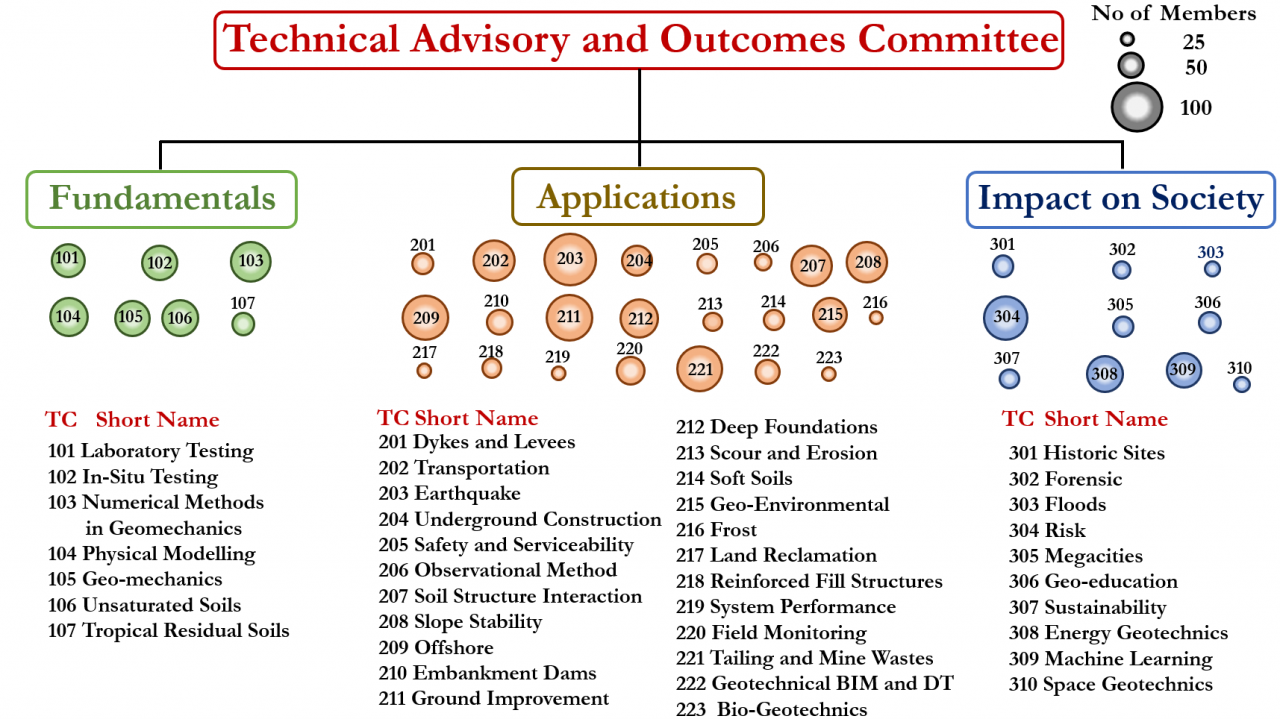 ISSMGE Technical Committees and their broad areas of activity. Circle size indicates the approximate number of members in each TC.
How to Join a Technical Committee
ISSMGE encourages its members to actively participate in Technical Committees. Any ISSMGE member interested in the activities of a TC can express their interest in joining; participation does not require waiting to be invited or nominated.
Members interested in joining a TC should contact their ISSMGE Member Society and request to be nominated as a member or corresponding member of the relevant Technical Committee. It is also recommended to contact the TC Chair and/or Secretary to express their interest and establish direct communication with the TC leadership.
Technical Committees welcome participation from members interested in contributing to their activities, including researchers, practitioners, younger members, and colleagues from all regions.
Why Join a Technical Committee?
Joining an ISSMGE TC provides opportunities to connect with the international geotechnical community, exchange knowledge, contribute to technical advances, and participate in initiatives with lasting professional and societal impact.
-
Connect with international experts: Collaborate with leading researchers, practitioners, and engineers from around the world who share common technical interests.
-
Exchange knowledge and experience: Learn about the latest research, innovative technologies, and engineering practices, and share experiences across different regions and professional environments.
-
Contribute to technical advances: Participate in developing technical publications, guidelines, recommendations, and other initiatives that advance geotechnical engineering knowledge and practice.
-
Enhance professional development and visibility: Expand your international network, participate in conferences, workshops, and educational activities, and gain opportunities for professional recognition and collaboration.
-
Support meaningful outcomes: Contribute to initiatives that address engineering challenges and promote safer, more sustainable, and innovative geotechnical solutions.
-
Be part of an inclusive international community: Engage with colleagues from academia and industry, including young professionals and members from different regions, and contribute your expertise and perspectives to the TC's activities.
TAOC Leadership Team
During the 21st International Conference on Soil Mechanics and Geotechnical Engineering (21st ICSMGE), held in Vienna in June 2026, ISSMGE President Prof. Lyesse Laloui appointed Dr Marcelo Sanchez as Chair of the TAOC for the 2026-2030 term. Dr Sanchez previously served as Chair of the TOC during the 2022-2026 term. Following his appointment, Dr Sanchez appointed Dr Mabel Chedid as Vice-Chair and Dr Liuxin (Lucy) Chen as Secretary of TAOC.
Chair
Dr Marcelo Sanchez
Professor and Fred J. Benson Chair, Zachry Department of Civil and Environmental Engineering
Texas A&M University, USA
Vice-Chair
Dr Mabel Chedid
Senior Geotechnical and Tunnel Engineer
WSP, USA
Secretary
Dr Liuxin (Lucy) Chen
Assistant Professor
RMIT University, Australia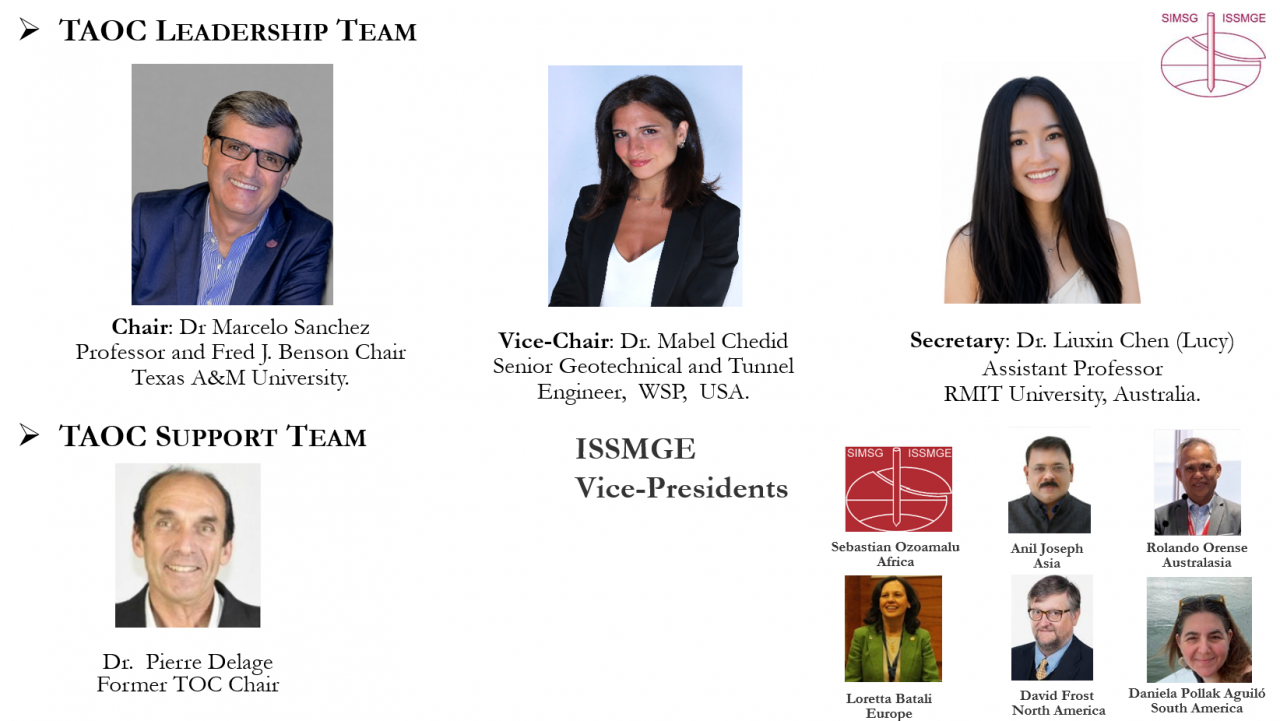 TAOC Leadership and Support Team for the 2026-2030 term.
TAOC Vision 2026-2030
TAOC will build on the successful activities of the Technical Committees while encouraging a stronger focus on meaningful technical outcomes and lasting contributions to ISSMGE and the broader geotechnical community.
The approach will be collaborative and bottom-up, recognizing the diversity of disciplines represented within ISSMGE. Individual TCs will be encouraged to identify the areas in which they can make the greatest contribution and to develop outcomes that reflect their particular expertise, priorities, and activities.
Particular emphasis will be placed on strengthening collaboration among TCs, promoting interdisciplinary initiatives, improving communication between the TCs, Member Societies, and the ISSMGE Board, and increasing the visibility and dissemination of TC activities and achievements.
For further details on the Committee's vision, priorities, and proposed initiatives for the 20262030 term, please see the [TAOC Vision 2026-2030] document.
TAOC Activities and Support for Technical Committees
During the 2026-2030 term, TAOC will continue to advise and monitor the activities of the Technical Committees while developing opportunities for their growth, collaboration, and interaction. The emphasis will be on supporting active and effective TCs and facilitating initiatives that enhance their contribution to ISSMGE and its members.
Regular interaction between TAOC and the TCs will continue through annual TAOC - TC Chairs meetings, providing a forum to discuss ongoing activities, share experiences and good practices, identify common challenges, and explore opportunities for collaboration among TCs.
The Small Projects initiative introduced during the previous term will also continue, providing support for focused activities proposed by the TCs. During the 2026-2030 term, opportunities will be available for larger projects, with funding of up to £5,000 for selected initiatives.
TC leadership teams are responsible for becoming fully familiar with the Guidelines for ISSMGE Technical Committees and ISSMGE Honour Lectures presented in the previous section and for ensuring that the organization and activities of their TCs are conducted in accordance with these Guidelines.
To reflect the international character and diversity of ISSMGE, TC Chairs are strongly encouraged to appoint a Secretary and, where applicable, a Vice-Chair from Member Societies different from that of the Chair and, preferably, from different ISSMGE regions. When selecting Chair-nominated members, TC Chairs are also encouraged to broaden the composition of the committee by considering colleagues from countries, regions, professional sectors, and other groups that are underrepresented within the TC.
TAOC will maintain regular monitoring of TC activities to encourage active engagement with ISSMGE members. Two important milestones in this process will be the mid-term and final reports. These reports will be based on surveys prepared by TAOC and will provide a systematic assessment of TC activities and achievements, allowing the activity and performance of the TCs to be evaluated and compared.
TCs identified as having a low level of activity or being inactive will be invited to meet with TAOC to discuss their status, identify the reasons for limited activity, and consider appropriate actions to revitalize the committee. Where continued inactivity is identified, TAOC may recommend changes in TC leadership to the ISSMGE President in accordance with the Guidelines.
In particular, TCs will be strongly encouraged to:
- hold regular meetings, with at least two meetings per year;
- maintain active and up-to-date webpages;
- organize international conferences, workshops, and other specialist technical events;
- contribute sessions and other activities to ISSMGE international and regional conferences;
- develop technical outputs and initiatives that disseminate knowledge and support professional practice;
- encourage active participation from both academia and industry, as well as younger members and members from different regions; and
- explore opportunities for collaboration and joint initiatives with other TCs and relevant organizations.
Interaction and Collaboration among Technical Committees
Strengthening interaction among TCs was another important objective. Information collected through the TC reporting process was used to map existing and planned interactions across the Technical Committee network. The resulting network provided a useful tool for identifying existing collaborations and opportunities for new interdisciplinary activities.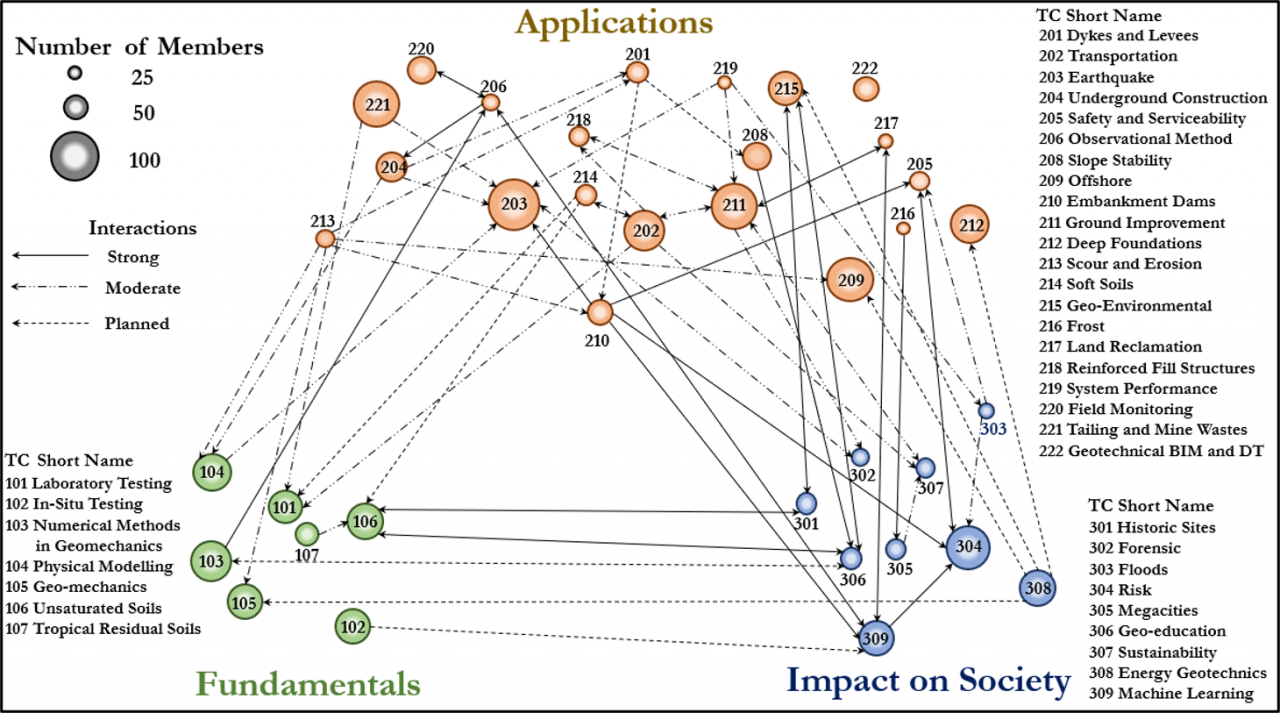 Interactions among ISSMGE Technical Committees during the 20222026 term. The network mapping was used to visualize existing and planned interactions and to identify opportunities for increased collaboration among TCs.
ISSMGE Open Access Policy
An essential mission of the ISSMGE is to provide up to date technical and scientific information to contribute to the improvement of knowledge easily available for the profession. Following the ISSMGE Open Access policy (see the ISSMGE Publication and Conference Manual), TCs are strongly encouraged to publish in Open Access their scientific production, and particularly the Proceedings of their Conferences, Symposium and Workshops that they organise. It is also important, and not too difficult, to promote the Proceedings through major databases, as described in this report.